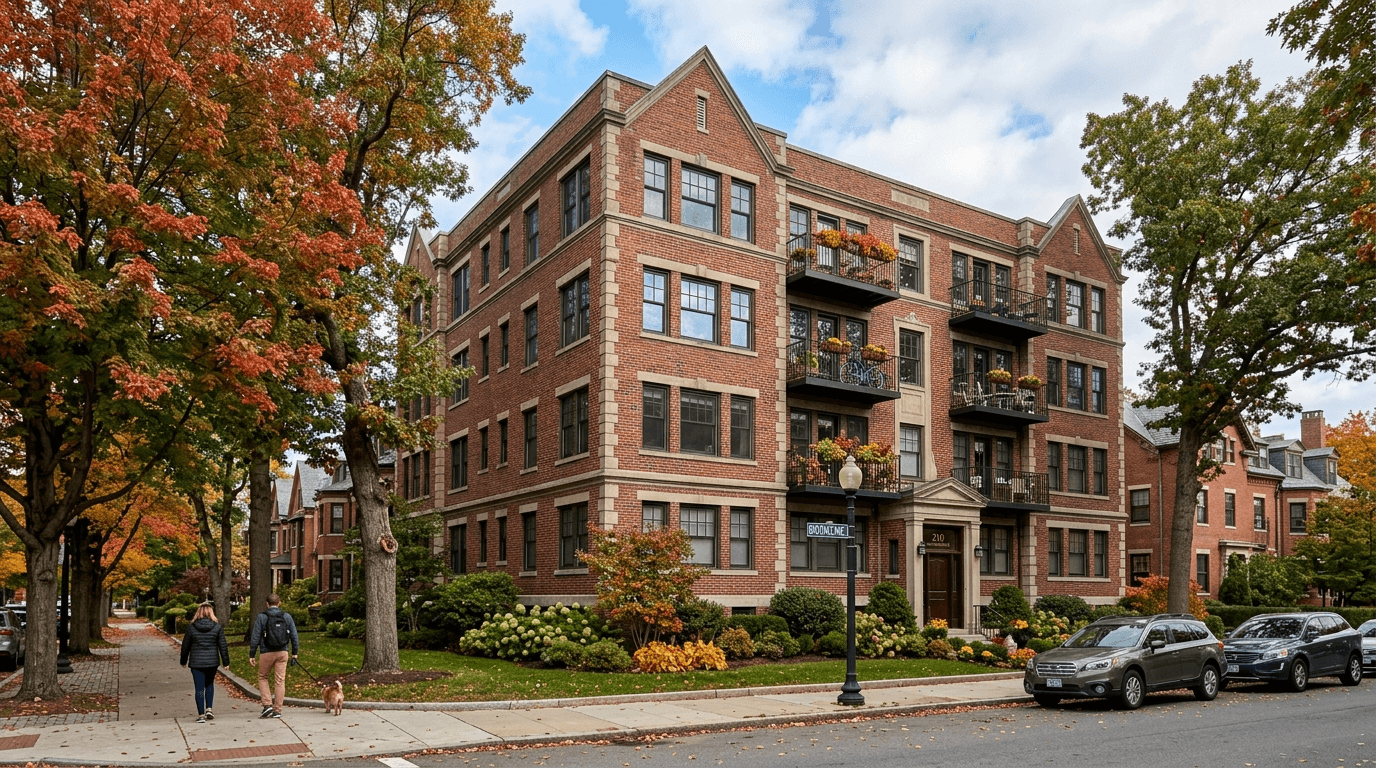

Will You Owe Capital Gains Tax When You Sell Your Brookline Home? How the Federal Home-Sale Exclusion Works
Key Takeaways
•The direct answer: Under IRS Publication 523, owners who lived in their home 2 of the last 5 years may qualify for a capital gains tax exlusion on the first $250,000 of gain if single, or $500,000 if married filing jointly.
•The Massachusetts catch: Per the Massachusetts Department of Revenue, taxable long-term gain is taxed at 5% (8.5% if held one year or less), plus a possible 4% surtax.
•The bottom line: Run your numbers with a tax professional before you accept any offer.
Why Should Brookline Sellers Ask This Question Now?
Recent tracked Brookline closings show a $1,253,750 median sale price.
Brookline buyer budget check: median, middle range, and price per square foot
A practical buyer-facing snapshot showing the reported median, middle-half price band, price per square foot, and sample size for recent Brookline closings.
Resideline tracked closings
Median home price$1,253,750
25th percentile / lower middle$765,000
75th percentile / upper middle$2,150,000
Median sold $/sqft$819
Tracked closings, last six months378
Source:Resideline tracked closings (as reported)
At those prices, the real question is simple: "How much of my profit do I actually get to keep?"
Do You Pass the Ownership-and-Use Test?
Under IRS Publication 523, you generally need to meet two tests:
•You owned the home for at least 24 months, or 2 years
•You lived in it as your main home for at least 24 months, or 730 days
You also generally cannot have taken the exclusion within the prior 2-year period.
The basic IRS eligibility tests for the home-sale exclusion
A concise eligibility checklist for the main IRS ownership, residence, and look-back rules for claiming the home-sale exclusion.
| Category | Ownership requirement | Residence requirement | Look-back/eligibility frequency |
|---|---|---|---|
| Time owned to meet requirement | 24 months (2 years) | - | - |
| Time used as residence to meet requirement | - | 24 months (2 years) / 730 days | - |
| Exclusion can be taken only once every | - | - | 2-year period |
How Much Can You Exclude From Tax?
IRS Publication 523 caps the exclusion at:
•$250,000 for single filers
•$500,000 for married couples filing jointly
•$500,000 for qualifying surviving spouses
Federal home-sale capital gains exclusion by filing status
A comparison of the maximum federal gain exclusion amounts shown in IRS Publication 523 for common filing-status scenarios.
| Series | Label | Value |
|---|---|---|
| Maximum exclusion | Single filer | $250,000 |
| Maximum exclusion | Married filing jointly | $500,000 |
| Maximum exclusion | Surviving spouse | $500,000 |
That doesn't make your whole sale price tax-free — it means that amount of gain, your profit after what you paid and certain costs, may be excluded.
If you rented the home out, moved early for work, divorced, inherited the property, or only one spouse qualifies, don't guess. Those details can change the answer.
How Do You Calculate Your True Gain?
IRS Publication 523 walks through three numbers.
1. Amount realized — Your sale price minus selling costs, such as broker fees and closing costs.
2. Adjusted basis — Usually what you paid, plus major capital improvements such as an addition, kitchen renovation, or new roof.
3. Taxable gain — Subtract your adjusted basis from your amount realized, then subtract your exclusion if you qualify.
For illustration, suppose a married couple bought for $300,000 and sells at that $1,253,750 median. Before costs and improvements, that creates a $953,750 gain. After the exclusion for joint filers, $453,750 may be taxable.
Your assessed value (the value the town sets for property tax bills) isn't your market value and doesn't decide your gain. Your purchase price, improvements, costs, and sale price do.
How Much Will Massachusetts and the IRS Take?
According to the Massachusetts Department of Revenue, long-term capital gains are taxed at 5.00%. Short-term gains, for homes held one year or less, are taxed at 8.5%.
The state also applies a 4% surtax (an extra tax on top of the regular rate) on income above a yearly adjusted threshold. A large home gain plus salary or investment income can push you over that line, so confirm this year's figure with your tax pro.
On the federal side, Thrivent's summary of IRS thresholds shows 2026 long-term capital gains rates of 0%, 15%, and 20%. Married couples hit the top bracket above $613,700 of taxable income.
What Should You Do Before You List?
Gather your purchase closing statement, improvement receipts, selling cost estimates, and the dates you lived in the home. Then bring those numbers to a tax pro — a CPA, ideally — before you accept an offer.
If you want help estimating your likely Brookline sale price before that meeting, reach out. We can build the real estate side of the worksheet so your tax pro can give you a clearer answer.